

O Diversity Census has ceased to be a one-off HR initiative and has taken on a more strategic role in companies. When well structured, it helps to understand the composition of the workforce, identify inequalities and guide more consistent decisions on culture, inclusion, belonging and development.
In practice, this survey creates a concrete basis for the DEIP strategy, which stands for Diversity, Equity, Inclusion and Belonging. This means moving away from actions guided by perceptions and towards management based on data, evidence and real priorities.
This change in outlook is important because the market no longer responds well to generic speeches about inclusion. Intention and positioning count, but it's the data that makes it possible to turn commitment into priority and priority into action.
Recent research shows that companies are more mature when they manage to link diversity, inclusion, belonging and an analytical reading of the internal environment. In this guide, we will show you how to carry out a diversity census, what to analyze after collection and why this process should be linked to management indicators.
What is the Diversity Census?
The Diversity Census is a structured survey of the demographic, social and cultural characteristics of the workforce. It helps the company to identify who is present, in which spaces these people are and how this presence is distributed between areas, positions, leaderships and career paths.
Among the most common markers are gender, race, ethnicity, age, disability, sexual orientation, education and gender identity. Socio-economic background, religion, parenting, generation, territory and other factors relevant to the organization's reality can also be considered.
This analysis need not be limited to numerical presence. In more mature companies, the census can also support readings on respect, accessibility, psychological safety and a sense of belonging.
When this happens, the survey it is no longer just an institutional snapshot and can support DEIP decisions more precisely.
This reading speaks directly to discussions about diversity and inclusion and with the construction of a inclusive culture in companies. Without reliable data, the company may be able to sustain its discourse, but it finds it more difficult to sustain its direction.
Diversity and inclusion census: why does it matter?
Many organizations still treat Diversity and inclusion census as an isolated action. The problem is that, on its own, it doesn't transform culture, it doesn't correct inequalities and it doesn't guarantee advances in the experience of collaborators.
The real value comes when the company uses this survey to understand patterns, locate gaps and review practices. This can involve hiring, promotion, development, remuneration, accessibility, leadership, climate, belonging and risk prevention.
Another important point is that the census improves the quality of the internal conversation. Instead of relying on scattered perceptions, the organization can discuss diversity more precisely, identifying where there is real progress and where there are still persistent barriers.
This gain becomes more relevant when the aim is not just to measure presence, but to understand the experience. Having diverse people in the organization doesn't automatically mean that everyone has a voice, security, recognition and opportunity.
What is the purpose of a Diversity Census in companies?

The Diversity Census serves to map the composition of the company in greater depth. It shows who is in the organization, where these people are positioned and what inequalities may be being reproduced throughout their professional journey.
It also serves to guide priorities. Without this portrait, As a result, the company tends to devote energy to generic actions, with little adherence to the problems it really needs to tackle.
In practice, the survey can support fronts such as:
- diagnosis of representativeness;
- reading inequalities between areas, positions and levels;
- review of recruitment and promotion criteria;
- monitoring inclusion targets;
- identifying cultural and relational risks;
- strengthening DEIP governance;
- analysis of belonging and internal experience.
This more strategic use moves the issue forward. The census is no longer just a form and is now part of an evidence-based management logic, connecting diversity to culture, career, leadership and indicators.
A company may discover that it has diversity in the general workforce, but a low presence of certain groups in leadership positions. It may also identify areas with higher turnover, less belonging or a lower perception of fairness.
How to conduct a Diversity Census?
When the search is for how to make a Diversity Census, The most useful answer doesn't lie in a ready-made model. It lies in the combination of a clear objective, good communication, security in the process and real capacity to act after the collection.
Companies that start out without this design run a common risk. They gather relevant data, but fail to turn the information into a practical priority. The result is a report that is interesting but poorly connected to the management routine.
1. Define the objective before collection
The first step is to understand why the company wants to carry out the census. Without a clear objective, the questionnaire grows too long, communication loses focus and the final analysis becomes blurred.
The aim can be to map representativeness, understand belonging, cross-reference diversity with career or identify accessibility barriers. Each choice changes the research, the way of communicating and the subsequent analysis.
Technology can greatly support the process, especially when it comes to collecting, consolidating and reading data. Even so, it is no substitute for strategy, governance and clarity about what will be done with the information.
2. Choose useful, clear and respectful questions
The questionnaire needs to be objective, understandable and compatible with the company's reality. Excessive, confusing or invasive questions reduce participation and affect the quality of responses.
In general, this type of survey includes topics such as gender, race, age, disability, sexual orientation, education and gender identity. In more mature contexts, questions about respect, appreciation, safety, accessibility and experience in the workplace can be included.
The point is not to ask everything. It's asking what will actually be analyzed and used responsibly.
Sensitive questions require careful language, the possibility of self-declaration and the option not to answer. The company also needs to explain why certain information is being requested and how it will be protected.
Privacy, anonymity and trust in the census
No census works well when people distrust the use of the data. Adherence drops, responses become superficial and the result loses analytical value.
Data on race, religion, health, disability, sexual orientation, gender identity and other sensitive dimensions require special care. The processing of this information must respect the LGPD, confidentiality and the prevention of any discriminatory use.
In practice, the company must explain:
- how the data will be stored;
- who will have access to the information;
- how the results will be analyzed;
- how the lessons will be presented;
- which cuts will be avoided to protect identities;
- what the next steps might be after the survey.
This point is decisive because trust has an impact on the quality of the data. The more secure and transparent the process, the more useful the final reading tends to be.
Protecting information is also linked to psychological safety. When an organization takes care of the way it collects and handles data, it reinforces that diversity is not just an image issue, but a responsibility agenda.
How can the census be communicated to increase membership?
Communication should not sell census as a symbolic gesture. It needs to explain why the company is asking, what it will do with the data and how the process protects those who participate.
This helps to reduce noise, resistance and low adherence. It also shows that the organization is taking the issue seriously.
What communication needs to make clear
The best communication is direct. It explains the process, gives deadlines, sets limits, reinforces confidentiality and shows that there is a real commitment to analysis and deployment.
Leaders also need to be prepared. When leaders don't understand the purpose of the census, they can convey insecurity to their teams. When they understand the process, they help build trust and legitimacy.
During the collection, communication reinforcements may be necessary. These reminders should preserve the voluntary nature of participation and avoid any sense of individual obligation.
The invitation must have consequences. Employees must understand that their responses can lead to concrete changes in culture, internal policies and management practices.
What to analyze after collection?
The analysis of census should not stop at overall percentages. Knowing the total composition of the company is important, but this figure alone says little about inclusion.
The most strategic question is where diversity is present and where it is not. The company needs to look at areas, positions, seniority levels, leadership, units and stages of the professional journey.
It should also analyze hiring, promotion, retention, development and recognition. This analysis shows whether inclusion is distributed or concentrated at specific points in the organization.
A company can have diversity in the general workforce, but a low presence in decision-making positions. It may have good entry indicators, but greater losses in certain groups. It may communicate inclusion, but have a low perception of belonging.
The analysis must also consider intersectionalities. Gender, race, disability, age, sexual orientation and socioeconomic background do not act separately in people's experiences.
This type of reading requires care to preserve anonymity. Even so, it is important to avoid generic solutions that do not respond to specific inequalities.
Indicators that turn the census into management

This is the point at which many companies stop too soon. They collect the data, create charts and end the conversation.
The most strategic gain comes when the census data is cross-referenced with business and internal experience indicators. This includes issues such as promotion, leadership, turnover, remuneration, internal mobility, absenteeism, whistleblowing, climate, engagement and recognition.
This cross-checking changes the quality of the analysis. The data ceases to be merely descriptive and begins to support decisions. The company begins to understand not only who is present, but how different groups go through their professional journey.
Some questions help guide this reading:
- Which groups have the lowest promotion rate?
- Which areas have the highest turnover?
- Are there salary differences between comparable groups?
- Who participates in development programs?
- Which leaders have the lowest perception of belonging?
- Which groups report the most accessibility barriers?
- Where are there more cultural or relational risks?
This reading connects diversity to governance, risk and the sustainability of culture. It also brings DEIP closer to topics that are already on the executive agenda, such as retention, performance, reputation and decision-making.
In companies that want to mature at this stage, reading about data, inclusive cultures and DEIP strategy fits naturally into the process. The same goes for the organization of inclusion targets and indicators.
When the census talks to indicators, it is no longer just a report. It becomes a management tool.
Belonging: what demographic data alone can't show
The demographic census shows who is in the company. It doesn't show, on its own, how these people experience the culture.
That's why belonging must be part of the strategic reading. An organization can have numerical diversity and low inclusion in everyday experience. People can be present, but not feel heard. They may hold positions, but have no real influence.
Measuring belonging helps to identify these differences. The company then observes whether different groups have different experiences of recognition, security and opportunity.
This reading qualifies the action plan and prevents the organization from confusing presence with inclusion. Diversity answers who makes up the environment, inclusion shows how this environment works and belonging reveals whether people can recognize themselves in it.
When these three dimensions are analyzed together, the diagnosis is more complete. The company understands not only where there is diversity, but where there are still barriers to full participation.
Common mistakes when applying a Diversity Census
Some mistakes reduce the quality of the census before the analysis even begins. The most common is to ask too many questions, creating a questionnaire that is long, tiresome and poorly connected to the decisions the company wants to make.
Another recurring mistake is to treat the collection as if it were neutral. Every sensitive question requires context, protection and clarity of purpose, especially when it involves social markers historically associated with discrimination.
It's also common to publicize the survey without preparing leaders or agreeing on the next steps. This undermines trust and makes the process seem improvised.
Among the main points of attention are:
- too many questions with no clear purpose;
- lack of communication about the use of data;
- poor leadership preparation;
- cut-outs that can expose people;
- analysis restricted to aggregate data;
- lack of feedback to the organization;
- no action plan following the results.
Resources such as diversity heat map help to visualize concentrations, gaps and points of attention more precisely. The same reasoning applies to the analysis of belonging and inclusive culture.
The process needs to close the loop. Collecting, analyzing, returning learnings and taking action are all part of the same journey.
When the census becomes a strategic tool
A census becomes strategic when the company stops using it as a symbolic response and starts treating it as a management tool. This requires method, data protection, analytical maturity and a commitment to real results.
Representativeness matters, but it doesn't end the conversation. The organization needs to understand who enters, who grows, who stays, who leaves and who experiences the most barriers during this journey.
It is this reading that brings the diversity of results, risks and sustainability of the culture closer together. When this level of analysis is in place, the census ceases to be just a static diagnosis and begins to help the company prioritize resources, guide leaders and correct weaknesses more precisely.
It also strengthens the governance of DEIP, because it transforms intent into goals, follow-up and shared responsibility. This advance is important for organizations that want to integrate governance and inclusion at the heart of the strategy.
Diversity X-ray: how to read the census more deeply
O Diversity X-ray PlurieBR extends the potential of the census by transforming demographic data into a more strategic reading of DEIP. Instead of just showing who makes up the company, it captures data in real time, analyzes how different groups are distributed by area, position and leadership and identifies where there are barriers and opportunities for action.
With dashboards by social group and filters by leader, area and intersectionality, the company gains precision in its analysis. It measures representativeness, assesses the sense of belonging and cross-references people management indicators with market benchmarks to guide priorities.
The Diversity X-Ray also maps concrete risks: harassment, discrimination, accessibility and financial exposure. This reading connects diversity to governance, reputation and business results. This strengthens the construction of action plans that are more in line with the company's strategy, with clear priorities and monitoring over time.
In the images below, you can see how it works in practice: dashboards with census data, maturity indicators, belonging, risks, demographics and points of attention to support decision-making.
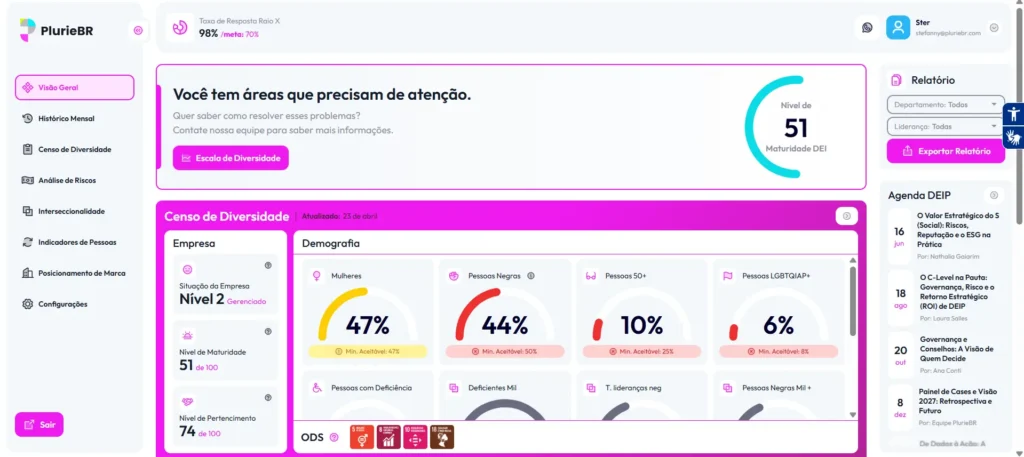
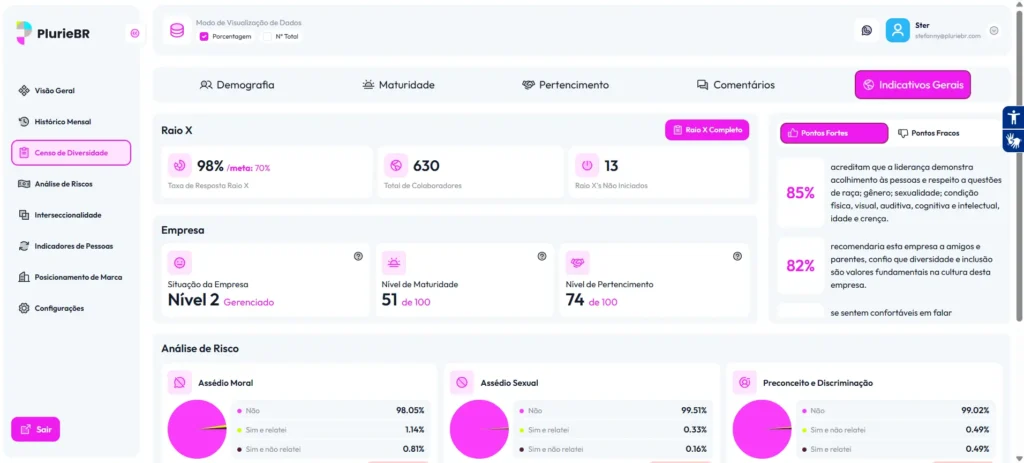
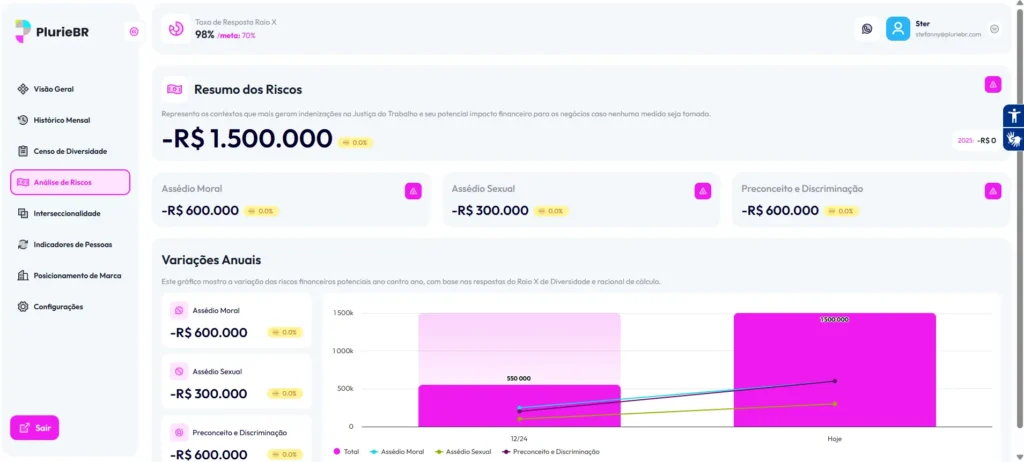
With automatic monthly management reports, the leadership receives ready-made indicators without having to compile them manually. The company can monitor the evolution of representativeness, belonging and risks over time, comparing results between areas, cycles and social groups.
When this becomes part of the routine, the census goes beyond collection and functions as an ongoing management tool for culture, leadership and inclusion.
The next step to using the Diversity Census more intelligently
The Diversity Census works best when it is linked to concrete decisions and a broader view of the organizational experience. Companies that want to mature this agenda gain more consistency when they address the issue with method, protection, analytical reading and data-driven management.
It's not enough to know how many people belong to certain groups. We need to understand whether these people have access, a voice, security and opportunity.
When this approach becomes part of management, inclusion ceases to be a promise and begins to guide priorities, resources and responsibilities. With the support of a data-driven management, o Diversity Census it is no longer just an internal survey, but a more consistent choice for culture, governance and results.